
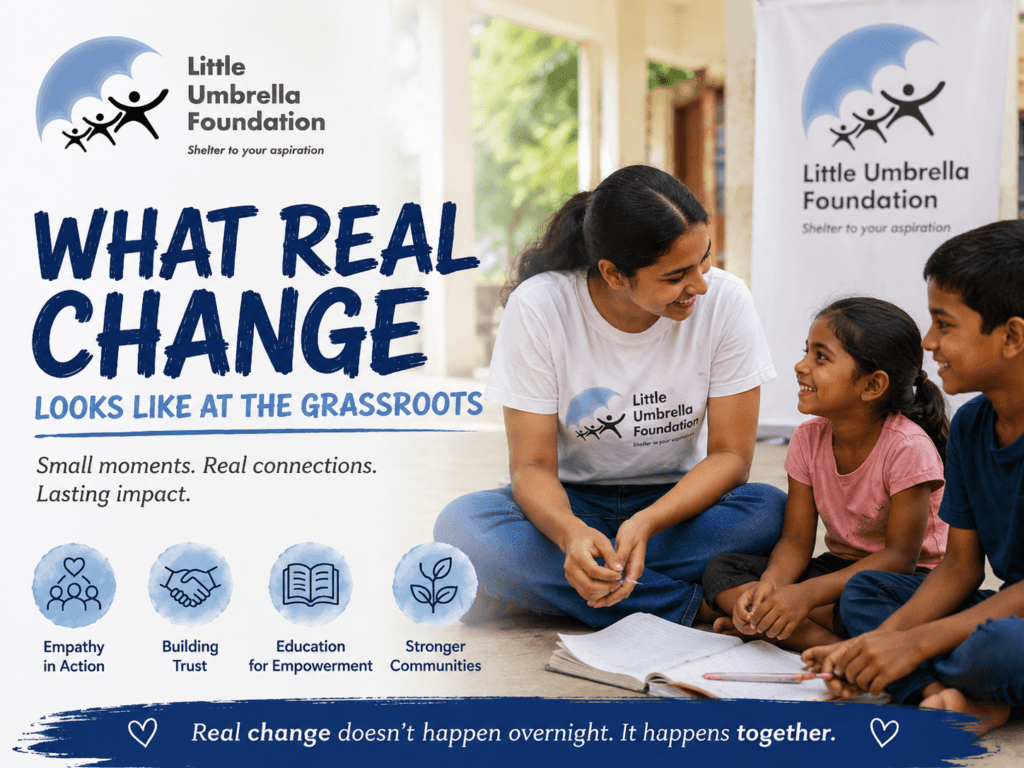
When people discuss “change,” they frequently imagine something significant and dramatic. At Little Umbrella Foundation, however, actual change is considerably more subdued. Small classrooms, casual chats, and moments that might not seem remarkable to the outside world but are extremely meaningful to the person experiencing them are all places where it occurs.
One crucial lesson we’ve learned from working at the grassroots level is that genuine change doesn’t always shout. It expands gradually. (Chambers, 1983)
It resembles a kid who used to sit in the last corner of the room, slowly raising their hand to respond to a question while avoiding eye contact.
It appears to be a mother who is cautious and unsure when she attends her first session, but returns the following week with greater confidence.
It appears to be a young girl who has the courage to proclaim, “I want to study further,” despite the challenging circumstances.
These incidents might not be reported in the media. However, they transform lives. (Kenny, 2011)
Beyond Reports and Numbers
Impact is frequently quantified in terms of the number of communities reached, the number of workshops held, and the number of students enrolled. Although these figures are significant, data cannot adequately represent grassroots change. (Sen, 1999)
Since genuine change is emotional.
It’s private.
It is a human.
We witness this on a daily basis at LUF. We witness kids who gradually start to think that their dreams are important. We witness kids gaining self-worth in addition to academic knowledge. Sometimes the most significant development is just a child grinning more broadly than before. (Volunteer with us)
The Strength of Being Present
The goal of grassroots work is not to go into a community and try to “fix” things. It’s about being present every time. Observing. Gaining comprehension and trust. (Chambers, 1983)
Financial strain, a lack of options, and social barriers are among the everyday struggles that many of the families we assist deal with. It is impossible to impose change in such settings. It needs to be cared for with tolerance and compassion. (Bank, 2002)
With time, a lovely thing starts to happen. Trust increases. Discussions become transparent. Involvement rises. Self-confidence rises.
We have witnessed kids who used to doubt themselves now serve as role models for others. We have witnessed women uncover their own strengths. These changes don’t happen quickly; they are the outcome of consistent belief and support. (Kenny, 2011)
Empathy-Based Change
Empathy is the cornerstone of Little Umbrella Foundation, not just one of our values. We recognize that each child has a unique narrative to tell. Silent struggles are carried by every woman. Every community also has a unique rhythm.
Those stories are respected by genuine grassroots change. It doesn’t take their place. It makes them stronger.
We do more than just impart knowledge through projects for empowerment and alternative education. We establish secure areas. We welcome inquiries. We rejoice in little victories. And gradually, fear starts to give way to confidence. (Sen, 1999)
A Journey We Take Together
At the grassroots level, real change takes time. It is constructed daily via consistency, attention, and presence.
Change Based on Empathy
At Little Umbrella Foundation, empathy is more than simply one of our core beliefs. We understand that every child has a story to share. Every woman faces silent struggles. Every community has its own rhythm as well.
Sincere grassroots transformation respects those stories. It doesn’t replace them. They get more powerful as a result.
Through initiatives for alternative education and empowerment, we do more than just teach. We create safe spaces. Inquiries are welcome. We celebrate small triumphs. And with time, confidence begins to replace dread.
A Trip We Take Together
Real change at the grassroots level takes time. It is built every day via presence, consistency, and attention.
References
Bank, W. (2002). Empowerment and poverty reduction: A sourcebook. World Bank.
Chambers, R. (1983). Rural development: Putting the last first. Longman.
Kenny, S. (2011). Developing communities for the future (4th ed.). Cengage Learning.
Sen, A. (1999). Development as freedom.