
Let’s be honest for a second: parenting is exhausting. On any given day, your house can feel less like a home and more like a never-ending series of negotiations, reminders, and mini-explosions.
- “Put your shoes away.”
- “Stop teasing your sister.”
- “Why is your homework still not done?”
By the time the sun goes down, you realise your voice has been on a permanent high-volume setting, and you’ve spent the last twelve hours acting like a strict police officer. It doesn’t feel good for you, and it certainly doesn’t feel good for your child.
We’ve all been there. Traditional parenting has conditioned us to operate on a “search and destroy” mission—we watch our kids like hawks, waiting for them to mess up so we can correct them. But what if we flipped the script? What if, instead of waiting to catch them doing something wrong, we actively started catching them being good?
That is the entire heart of positive reinforcement.
The Trap of the “Squeaky Wheel”
Think about how we naturally react to our kids. When they are playing quietly in their room, sharing their toys, or reading a book, what do we do? We usually breathe a sigh of relief, look at our phones, or rush to do the dishes. We leave them alone because “they’re finally being quiet.”
But the moment they start screaming, throwing toys, or jumping on the couch, we fly into the room.
Unintentionally, we end up teaching our kids a funny little lesson: If I behave well, Mom and Dad ignore me. If I cause chaos, I get 100% of their attention within three seconds. To a child, even negative attention (yelling or scolding) is better than no attention at all.
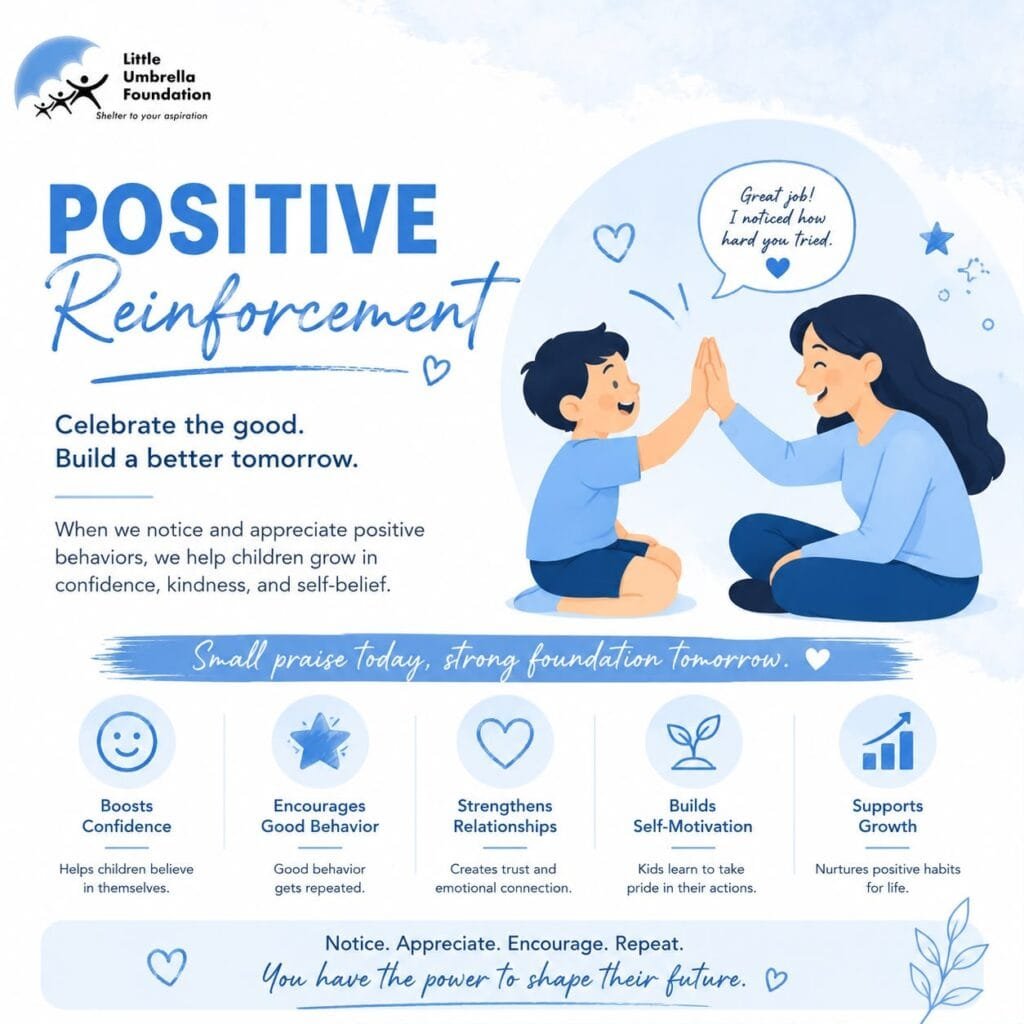
Positive reinforcement breaks this loop. It’s the simple psychology of noticing, naming, and rewarding the behaviours you actually want to see more of.
How to Do It Without Empty Praise
A lot of parents worry that positive reinforcement means showering kids with participation trophies or bribing them with toys every time they brush their teeth. But true positive reinforcement isn’t about material rewards—it’s about connection and notice.
Here is how you make it work in real life, without turning your kids into praise-addicts:
1. Praise the effort, not the trait
Instead of saying generic things like, “You’re so smart!” or “You’re a good boy,” focus on the specific action.
- Instead of: “Good job cleaning your room.”
- Try:“I noticed how you put all your blocks back into the red bin by yourself. That took a lot of focus, and it really helped me out.”
When you name the exact behavior, your child understands exactly what they did right, and they feel a genuine sense of pride.
2. The Power of the “Micro-Notice”
You don’t need a grand gesture to reinforce a good habit. Sometimes, a tiny bit of real-time validation is all it takes. If you walk past the living room and see your child sharing a toy with their sibling, don’t just walk past. Stop, catch their eye, smile, and say, “Hey, I love how nicely you just shared that car with your sister. That was really kind of you.” Then walk away. No big deal, but to them, it feels like winning a gold medal.
3. Use Experiences as Rewards, Not Things
If your child has had a fantastic week of managing their morning routine without a meltdown, you don’t need to buy them a new toy. Reward them with connection. Give them the privilege of staying up 15 minutes later to read an extra bedtime story, or let them pick what the family eats for Friday night dinner. Kids crave your presence far more than new plastic gadgets.
What Happens When They Still Mess Up?
Let’s be real: positive reinforcement isn’t a magic wand. Your child is still going to have tantrums, push boundaries, and test your patience.
The goal isn’t to ignore bad behavior, but to build up such a strong foundation of positive interactions that when you do have to set a firm boundary or issue a consequence, it actually lands. A child who feels seen, appreciated, and loved is naturally much more willing to listen to you when things go wrong.
Give Yourself a Break, Too
If you’ve spent years parenting through scolding and lecturing, switching to positive reinforcement feels awkward at first. You might catch yourself mid-yell, and that’s okay. Parenting is a practice, not a perfection game.
Tomorrow, try to go into the day with a new goal. Don’t look for the messes, the forgotten shoes, or the spilled milk first. Just look for one small, quiet moment where your child is doing something right—and let them know you saw it.
Anviksha Ranjan
5th July 2026
Intern