
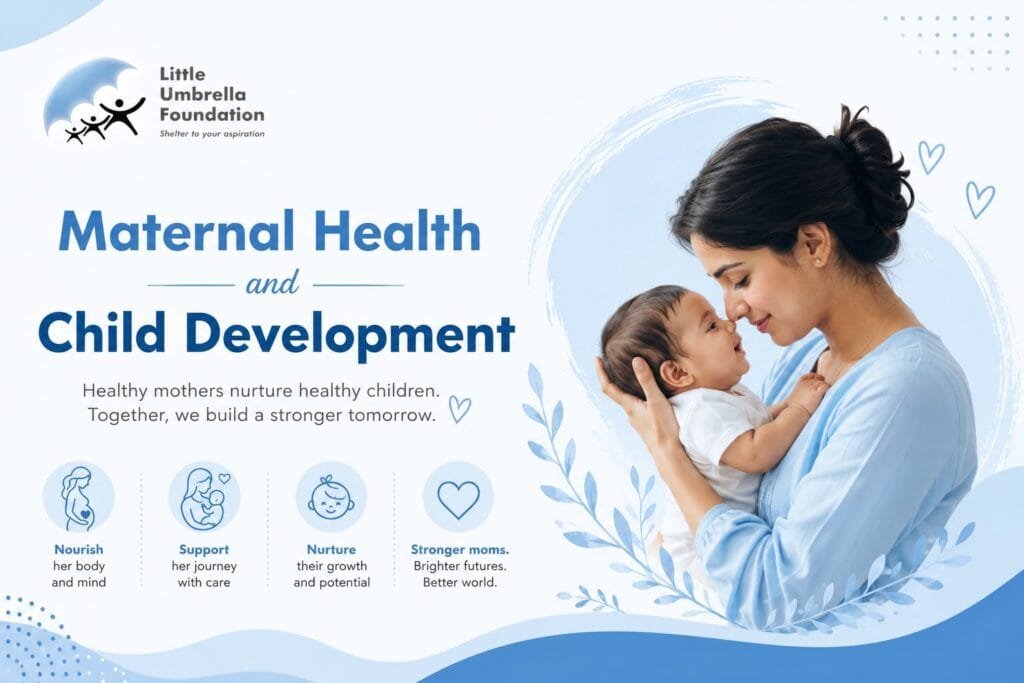
There is a beautiful, unspoken shift that happens the exact moment a new baby enters the world. Suddenly, all eyes in the room instantly rush to the crib. We obsess over the baby’s sleep schedule, their weight gain, the exact shade of their outfits, and whether they are meeting every single milestone on time.
But if you pan the camera over just a few feet, you’ll see someone else sitting in the quiet shadows of that same room—a tired, healing, completely overwhelmed mother.
As a society, we are incredibly good at pouring all our love, attention, and celebratory gifts into the child. But we often completely forget the woman who just went through a seismic physical, hormonal, and emotional earthquake to bring that child here.
We tend to look at maternal health and child development as two separate checkboxes. But the deep, beautiful truth is that they are entirely the same thing. You cannot look after a seedling without looking after the soil it grows in. If we want our children to grow up whole, resilient, and emotionally healthy, we have to start by fiercely protecting the well-being of their mothers.
The Silent Conversation in the Womb
For a long time, people assumed that a baby in the womb was completely insulated from the outside world, like a little astronaut in a spaceship. But we now know that a mother’s body acts as a literal translator for her baby.
When a pregnant woman is under chronic, unmanageable stress—whether from financial worry, toxic family dynamics, or emotional isolation—her body releases stress hormones like cortisol. That cortisol crosses the placenta. It carries a silent message to the developing baby, whispering clues about what the outside world is going to be like. If a mother is constantly running on fear and exhaustion, the baby’s developing nervous system subtly prepares itself to enter a stressful, unsafe environment.
This isn’t meant to make any pregnant woman feel guilty for having a bad day or shedding tears—crying and feeling stressed is just part of being human! Instead, it’s a massive wake-up call for everyone else around her. Ensuring a pregnant woman feels safe, loved, well-fed, and peaceful isn’t just about “spoiling” her. It is actively shaping the architecture of her child’s future brain.
The Postpartum Dance: Connection Over Perfection
Once the baby arrives, that invisible umbilical cord simply turns into an emotional one.
You’ve probably heard of the concept of a mother’s instinct, but in reality, it’s a daily, messy dance of connection. When a baby babbles, a mother smiles back. When a baby cries, a mother changes her tone of voice to soothe them. This simple back-and-forth interaction is what builds a child’s brain.
But what happens when a mother is drowning in postpartum depression, severe anxiety, or pure, bone-deep exhaustion?
When you are fighting your own darkness, it becomes incredibly hard to participate in that dance. An anxious mind is on constant high alert, making it hard to feel calm enough to soothe a fussy infant. A depressed mind struggles to read a baby’s subtle cues.
Let’s be crystal clear: a mother does not need to be a perfect, smiling, organic-cooking superhero twenty-four hours a day. Kids are remarkably resilient. They don’t need perfection. What they need is a mother who is supported enough by her environment to be emotionally present most of the time.
Retiring the Myth of the “Sacrificing Mother”
In our culture, we love to romanticize the image of the selfless, sacrificing mother. We praise the women who put themselves last, who skip meals, who ignore their own mental health, and who give up every ounce of their identity to serve their families. We wear maternal burnout like a badge of honor.
We need to stop doing that. Self-sacrifice isn’t a healthy parenting strategy; it’s a recipe for an empty tank. And you cannot pour love, patience, or security into a child from an empty cup.
Maternal health is not a solo sport. It is a family project and a societal duty.
If we want to help, we need to change how we show up:
- For partners:True support isn’t just saying “I love you.” It’s waking up for the 3:00 AM diaper change, taking over chores without needing a checklist, and standing as a shield between your partner and intrusive social pressures.
- For friends and family:When you visit a new mom, don’t just ask to hold the baby while she cooks or cleans for you. Hold the baby so she can take a long, hot shower, eat a hot meal, or take a nap. Look her in the eyes and ask, “How are you really doing?”—and stick around to hear the messy truth.
- For the mothers: Giving yourself permission to rest, to step away, to go to therapy, or to cry out for help isn’t selfish. Taking care of your mind and body is the very first, and most important, act of parenting you will ever do.
The Bottom Line
When we nurture a mother—when we protect her peace, validate her fears, and give her the space to heal—we aren’t just saving one woman. We are giving her child the greatest developmental head start possible: a healthy, regulated, and present parent.
To love the child, we must first learn to take care of the mother.
Anviksha Ranjan
6th July 2026
Intern