
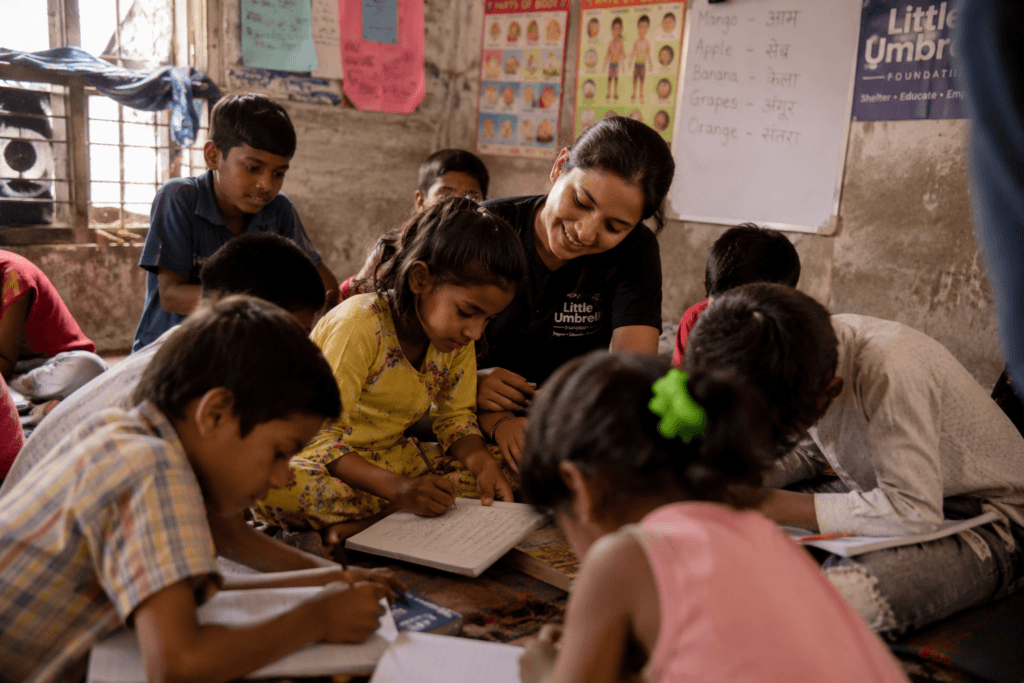
Every morning in Delhi NCR, millions of children leave home carrying school bags, notebooks, and dreams for the future. Yet many others still grow up without consistent access to safe learning spaces. Education for underprivileged children in Delhi remains one of the most important challenges affecting long-term child development, community growth, and equal opportunity.
In many parts of Delhi, school bells ring every morning. Children rush through gates with backpacks swinging behind them, carrying notebooks, lunch boxes, and dreams that feel possible.
A few kilometres away, another child begins the day very differently.
Instead of entering a classroom, they may be helping a parent at work, looking after younger siblings, collecting recyclable waste, or simply sitting outside a cramped home with no safe place to learn. Not because they lack curiosity. Not because they do not want an education. But because access to learning is still uneven for thousands of children living in underserved communities.
This is where the conversation about education for underprivileged children in Delhi becomes deeply important.
A classroom is not only a room with blackboards and benches. For many children, it becomes the first place where someone listens to them, encourages them, and reminds them that their future can be larger than their circumstances.
Organizations like Little Umbrella Foundation are working to bridge this gap through community learning initiatives, alternative education models, and youth-focused programs that help children rediscover confidence in learning.
Education Is More Than Literacy
When people think about education, they often imagine textbooks, exams, and report cards. But for children living in vulnerable urban communities, education creates something even more foundational: stability.
A consistent learning environment can help children:
- Build confidence and communication skills
- Develop emotional resilience
- Improve long-term health and well-being
- Reduce risks of child labour and exploitation
- Gain exposure to opportunities beyond immediate surroundings
- Strengthen problem-solving and social skills
According to UNICEF India, education plays a central role in breaking intergenerational cycles of poverty and inequality.
For many children in Delhi’s slum communities, the challenge is not intelligence or willingness to learn. The challenge is continuity. Frequent migration, financial instability, overcrowded housing, lack of digital access, and family responsibilities can interrupt schooling repeatedly.
Without support systems, many children slowly drift away from education altogether. Thus education for underprivileged children in Delhi becomes a priority.
Why Children in Urban Slums Often Miss Out on Learning
Delhi is a city of opportunities, but opportunity does not reach everyone equally.
Children living in informal settlements often face overlapping barriers that make regular schooling difficult.
Financial Pressure at Home
Many families work in unstable daily-wage occupations. When survival becomes the immediate priority, educational expenses—even basic ones like transport, uniforms, or stationery—can feel difficult to manage.
Lack of Learning Support
Parents may value education deeply but may not always have the time, literacy, or resources to support children academically at home.
Interrupted Schooling
Frequent relocation due to work or housing insecurity can cause children to change schools multiple times or stop attending entirely.
Digital Divide
The pandemic highlighted how unequal access to devices and internet connectivity can widen educational gaps. Children without digital access were often left disconnected from learning for long periods.
Unsafe or Overcrowded Environments
A child cannot focus on learning when there is no quiet or safe space to study.
This is why community-based classrooms and alternative learning centers are becoming increasingly important across Delhi NCR.
A Classroom Can Change the Direction of a Child’s Life
Sometimes transformation begins with something very small.
- A volunteer who remembers a child’s name.
- A teacher who notices their potential.
- A safe room where questions are encouraged.
- A storybook they can call their own.
At Little Umbrella Foundation’s programs, learning is approached as a human experience rather than a rigid system. Children are encouraged not only to study but to participate, speak, imagine, and grow.
Alternative education models can help children reconnect with learning in ways that feel accessible and meaningful.
Programs like the Certified Happy School Program and Virtual Vidyalaya Classes reflect how community-driven education can adapt to the realities children face today.
Community Learning Spaces Are Supporting Underprivileged Children
Not every child’s educational journey looks the same. Some children need after-school academic support. Others need foundational literacy assistance. Some need emotional encouragement before they can fully engage with structured education again. Community learning spaces help fill these gaps.
These spaces often provide:
- Flexible learning environments
- Individual attention
- Peer interaction
- Creative activities
- Digital exposure
- Mentorship opportunities
- Safe and inclusive surroundings
For children who feel disconnected from formal systems, community classrooms can become stepping stones back into sustained learning.
They also help create local support networks involving volunteers, educators, families, and young mentors.
The Role of Volunteers in Child Education
One meaningful conversation can leave a lasting impact on a child.
Volunteers often become important role models in community education programs. Beyond academics, they bring encouragement, empathy, and exposure to different possibilities in life.
Teaching a child basic reading skills matters. But so does helping them believe their voice deserves to be heard.
People from diverse backgrounds—students, working professionals, teachers, artists, and retirees—can contribute meaningfully through volunteer-driven education initiatives.
Those interested in supporting child education programs can explore the Join Us page by Little Umbrella Foundation to learn about volunteering opportunities and community participation initiatives.
Why CSR Partnerships Can Create Long-Term Impact
Corporate Social Responsibility initiatives have the potential to strengthen grassroots education programs significantly.
When companies support community learning initiatives, the impact can extend beyond funding.
CSR collaborations can help provide:
- Learning materials
- Digital education infrastructure
- Skill-building workshops
- Volunteer engagement programs
- Teacher training support
- Community outreach initiatives
- Technology-enabled learning access
Sustainable education programs require continuity, infrastructure, and collaborative effort. Partnerships between NGOs, local communities, educators, and socially responsible businesses can help create stronger educational ecosystems.
For organizations interested in collaborative social impact initiatives, Little Umbrella Foundation’s contact page provides ways to connect and explore partnership opportunities.
Alternative Education Is Not a Lesser Form of Learning
There is a common misconception that alternative education is only a temporary substitute for formal schooling.
In reality, alternative education often serves as a bridge.
It helps children regain confidence, develop foundational skills, and reconnect with learning at their own pace.
Programs focused on storytelling, arts, communication, digital learning, and experiential activities can improve engagement dramatically, especially among children who have struggled in traditional systems.
The goal is not simply to increase attendance numbers.
The goal is to create learners who feel seen, supported, and capable.
Education and Child Welfare Are Deeply Connected
When children access stable educational environments, the benefits extend far beyond academics.
Education influences:
- Mental well-being
- Social confidence
- Nutrition awareness
- Future employability
- Personal safety awareness
- Gender equality
- Community participation
According to UNESCO, inclusive education contributes significantly to sustainable community development and social equity.
For underserved communities, education can become a long-term protective factor that strengthens both individuals and families.
What Real Change Looks Like
Real change is not always dramatic.
Real change is not always dramatic.
It can begin with a child returning regularly to a learning center after months of hesitation.
Elsewhere, it may appear in the form of a teenager becoming the first in their family to complete secondary education.
Sometimes, it is simply a young girl discovering the confidence to speak openly and believe in her own voice.
And sometimes, it begins with someone simply believing that every child deserves the dignity of learning.
Across Delhi NCR, many organizations, educators, volunteers, and community leaders are working quietly every day to keep that belief alive. Thus education for underprivileged children in Delhi has become our first priority.
How Ordinary People Can Help
Supporting child education does not always require large-scale resources.
People can contribute through:
- Volunteering time
- Sponsoring educational materials
- Supporting digital learning access
- Conducting mentorship sessions
- Partnering through CSR initiatives
- Raising awareness responsibly
- Donating toward community education programs
Even small, consistent contributions can help sustain learning environments for children who may otherwise lose access to educational opportunities.
A Future Where Every Child Has a Place to Learn
Every city is ultimately shaped by the opportunities it gives its children.
When education remains inaccessible to large sections of society, the consequences affect entire communities over time. But when children receive safe spaces to learn, ask questions, and imagine possibilities, change begins to spread quietly and steadily.
A classroom may not solve every challenge overnight. Yet for many children, it becomes the first place where hope starts feeling practical.
And that is why every child in Delhi’s slums deserves one.
If you would like to support community education initiatives, volunteer programs, or collaborative social impact efforts, you can learn more through Little Umbrella Foundation and explore opportunities to participate in meaningful grassroots change.
FAQs
Why is education important for children living in slums?
Education helps children build confidence, improve life opportunities, develop essential skills, and reduce long-term social and economic vulnerabilities.
How do NGOs help underprivileged children access education?
NGOs support children through community classrooms, alternative learning programs, mentorship, digital learning initiatives, educational materials, and volunteer-led teaching support.
Can I volunteer to teach children in Delhi NCR?
Yes. Many NGOs, including Little Umbrella Foundation, offer volunteer opportunities for individuals interested in supporting child education programs.
What is alternative education for children?
Alternative education refers to flexible and community-focused learning methods that help children engage with education through creative, experiential, and accessible teaching approaches.
How can companies support child education initiatives?
Companies can support NGOs through CSR partnerships, digital infrastructure, educational sponsorships, employee volunteering, and long-term community education programs.
How can I donate to support children’s education in India?
You can support verified NGOs working in child education by contributing toward learning materials, classroom initiatives, digital education access, and community development programs.